'our creation is that guru; the duration of our lives is that guru; our trials, illnesses and calamaties is that guru. There is a guru that is nearby and a guru that is beyond the beyond. I humbly make my offering to the guru, the beautiful remover of ignorance, the enlightenment principle that is within me and surrounds me at all times.'
Guru Stotram

Tuesday, 22 June 2010


Herewith a labour of love comes to you from under the duvet, from whence I am planning on never emerging again. My friend Isabel called me on Friday afternoon to ask me where I was watching the football.

"What football?" I grunt gracelessly.
She's from California.
"Babes, there's like you and one other person in the whole country who doesn't know we're playing Algeria tonight."

A few minutes later I ring off, realising, as I hear the phone go click, that my assumption that the word 'we' refers to En-gur-luhnnd may be just that. A feeling of foreboding shivers through me as I contemplate the prospect of what I think may be my first ever full on 90 minutes of the so called beautiful game.

The foreboding was well placed it turned out as the result is a hangover so catastrophic it now seems unlikely I'll make it through to tomorrow. I may have said it before but this time I really mean it. If I do make it through to tomorrow I'm never drinking again. And I don't think I shall be watching football again either. It was rubbish. Thursday night was better and I spent that standing on the pavement in New Cross. The fire alarm went off during the Goldsmiths' Undergraduate private view, so I'd dragged my arse across the capital for the sake of five pieces of video work and some chapattis. The later looked just about ok on the Saatchi Show back in, what was it, January, but by last Thursday they were looking significantly past their sell by date. What, I wondered ungenerously, has Mr Qureshi been doing with himself for the last six months?

Anyway, I could have, I probably should have, hauled myself around the rest of the show, but frankly by the time I was back out on the pavement with all hell breaking loose in my ears, the prospect of a glass of ropey plonk down the Sun and Doves was looking like a tempting one. Although things didn't improve that much when we got there. The tills had broken down and arty young fellows these days, it transpires, aren't cut out for mental arithmetic. I enjoyed seeing the wave again though. The Great Wave off Kanagawa in reverse, writ huge on the side of a modest terraced house in Camberwell. It's a romantic thing to stumble upon in SE5. It restored me. Briefly. There's some beauty in the world it seemed to say, even if most of it is painful and melancholic. And transient. Horribly transient.


I suppose I'm being unnecessarily gloomy about the whole thing. It just seems that whatever happens, whenever things seem to be going even vaguely ok, life always manages to bring it back around to doing a big shit on you. Gives with one hand and punches you in the guts with the other. I'm not sure if that's how it really is or if that's just how it appears. And in a way what's the difference? What's the difference between reality and the appearance of reality? What's the difference between shit and the appearance of shit?

Anyway, I'll pick myself up and give myself a shake down, nothing too rumbustious, a gentle little jiggle ought to be enough for this evening. I'll be alright in the morning I expect. And the fact is that despite the premature debunk it hadn't been a waste of time at all actually. There was one piece of work – and it only takes one – that made the trip worth while and probably comes near the top of my 'best things I've seen so far in 2010' list. Twenty eight year old undergrad Helen Nymann Hansen's film Mother Mind - quite staggering really, despite maybe a slightly cheesy title. Part film, part performance, part immersive installation, it was atmospheric and archetypal and hypnotising. I was completely carried away into another world and it was a world that somehow felt far more real than the one I usually waste my time knocking around in.

But these things don't really communicate themselves in words. Especially not the words of a bear with a sore head. So I think I'll call it a day now and try and sleep it off. Hopefully the world will seem a sunnier place in the morning. Isabel tells me we're playing Slovenia on Wednesday. I think I might give that a miss though.


Wednesday, 16 June 2010


I
"Most of life is so dull that there is nothing to be said about it... Inside its cocoon of work or social obligation, the human spirit slumbers for the most part, registering the distinction between pleasure and pain, but not nearly as alert as we pretend. There are periods in the most thrilling day during which nothing happens, and though we continue to exclaim 'I do enjoy myself' or 'I am horrified' we are insincere. As far as I feel anything, it is enjoyment, horror – it's no more than that really, and a perfectly adjusted organism would be silent."
E.M. Forster, A Passage to India


II
I had to break up with my adored boyfriend yesterday - if such he was, I'm still not entirely sure, the word 'my' sits too awkwardly. It was over the email in the end, shockingly. As yet he hasn't responded. Oddly enough one does rather hope for a response at times like this, but never mind, I can't have it all ways I suppose.

Keen on the idea of a few Bovary-esque moments I'm going through occasional and short lived bursts of blaming the failure of this latest romantic debacle entirely upon Him, getting angry and so forth, hurling at the blank wall ahead of me imaginary insults on the voluminous subject of his great ineptitude, even contemplated falling into a swoon; then suddenly and unexpectedly, calm is restored, as though it never left. I put the kettle on.

The truth is I know it's as much my fault as his. I chose to become romantically attached to a man very recently separated knowing perfectly well the problems we'd encounter. I've been there myself. I know the form. We all have. So why did I go down that path? Why choose to be somebody's rebound fling? What does that tell me about myself, I wonder, knowing already the answer.

But I go through the motions nonetheless, the things one expects of oneself in these situations. I call my girlfriends and bore them rigid wailing about my heart ache; take valerian certain that I shan't sleep a wink otherwise; stop eating of course – the pounds are flying off - every cloud and all of that… I text my friend to tell her this. 'Bitch x' she texts back. I guffaw.

Then I catch myself humming in the shower and as I sit here I find I'm feeling not so very far off jolly, or more accurately, I'm feeling, I don't know, not that much.

I've changed the sheets, washed my hair, put his t-shirt – the one solitary possession of his that I have here – into a paper bag by the door. And that's it really. Doesn't add up to a great deal, does it? One lone paper bag by the door. One more failure notched up in a history of same. One more desperate parting. At least it's a brief reminder that I'm alive, a blessed glimpse of horror, a flash of something felt before the curtain falls once again.


III
In this oddly oscillating state of cherished aliveness I saw The Surreal House at Barbican. Everything was more intense, as though a layer of skin had been peeled away. It was an apt show to visit in the circumstances, its raison d'etre, and perhaps that of Surrealism's entire oeuvre, seemingly to shock the viewer out of her slumber, to poke her into a state of vivid aliveness with the disturbing yet strangely beautiful zap of an electric prod.


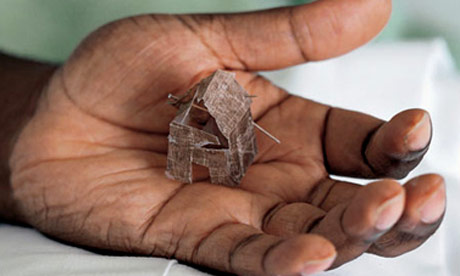
In the first room Donald Rodney's In The House of My Father hangs opposite Buster Keaton's 1928 projected feature film Steamboat Bill Jr.. Both works tragically sad. Rodney's heart-breakingly poetic image of the frailty of the human body – a tiny house consisting solely of pieces of his own skin held together with two pins that he made whilst in hospital suffering from sickle cell anaemia, of which he later died at the age of 37. Steamboat Bill Jr. features Keaton's most famous and oft referenced stunt in which the façade of a house collapses over him, his life saved by a whisker when the attic window passes over his head and down his body, as the façade slams to the ground - a reminder of the immense physical and emotional fragility we live with day-in-day-out but are almost never aware of. If we were more often aware of it how different our lives might be. In the moment might be the only way to live; compassion the only emotion.


In the background I can hear a noise that turns out to be Rebecca Horn's 1990 Concert for Anarchy. A grand piano is suspended upside down from the high ceiling. Periodically and (at first) unexpectedly, its innards are flung out to the accompaniment of a great cacophony of jarring sound, as though the piano's very heart were being torn out. The keys burst from the noble instruments metaphoric chest as though reeling from a grenade. Next the heavy lid swings open. The piano hangs in this state of vulnerability for a couple of minutes, part shocking and part wondrous revelation, before the keys are slowly and effortfully re-integrated back into the body of the whole and the lid quietly closes over the wounds. Once again the notion of an object complete and in control is presented to the world. Yet it remains, eternally suspended upside down from its legs, its absurd and agonising plight plain for all to see. And then, moments later, its heart is broken once again.


IV
"I did my best, it wasn't much,
I couldn't feel, so I tried to touch,
I've told the truth, I didn't come to fool you,
And even though it all went wrong,
I'll stand right here before the Lord of song,
with nothing on my tongue but Hallelujah"
Leonard Cohen

Friday, 11 June 2010


A mortification has occurred. I just sent a text message to the wrong person. Sent it to the friend I was complaining about rather than the one I was wanting to complain to. Feel like digging a large hole and climbing in. Possibly staying there forever. The recipient called me and informed me of my error, kindly and gently just to make matters worse. I employed the technique of last resort – pretended I thought it was fabulously funny. Who am I kidding?

Why does life insist on giving me these mirror moments in which to see myself with a clarity that I feel is just completely inappropriate? Delusion suits me fine actually thanks. I’m quite keen on a bit of denial as it goes. I do not need to know that I am a beastly ungenerous being. But now that I do know it (once again) I shall have to try and do something about it (once again). I’m not sure what. A pointless and short lived resolution to be less beastly and ungenerous I suppose. And yet already I feel the mortification fading, the protective cloak of self delusion closing in around me and I know that, of course, I shall continue to be the beast that I am, inhabiting my own little world with moi in the lead role and moi in all supporting roles. It’s rather depressing if you think about it.

And Berlin was rather depressing in the rain. The rain followed me around Europe this week. The minute I arrived anywhere the rain began and the minute I left the sun came out. London, Hamburg, Berlin, Porto Fino, London.

For a whole day I thought Berlin was the most rubbish place I’d ever been. I arrived on Monday. As in London, galleries in Berlin are closed on Monday. At least in London you can go to a public gallery. In Berlin - not a bloody wurst. Actually there was one thing open - The Deutsche+Guggenheim. Hmmm, is it a bank or is it a gallery? It’s a bank folks. With some pictures in it. Pictures by Wangechi Mutu as it happened. I didn’t like them. I’m fed up with Post-Colonialism. To the back teeth. “Mutu counters the manifest idea that she is perhaps an ‘African’ artist who draws on the culture of her home continent in her work with a multiperspectival cosmos. The alienation and uprooting in her images and installations is obvious… migrants… blah … hybrid… blah … ‘AlieNation’… blah….”

On Tuesday I ‘borrowed’ a parka from the apartment I was staying in and things began to improve. Hot I can handle, cold not. What this thermostatic failure meant was that I spent Tuesday and Wednesday embroiled in an ethical dilemma. Is it morally defunct to borrow the unlent? I don't know, but in the end the parka and I managed somewhere in the region of fifty odd galleries over a period of two and a half days, a smallish fraction of the four hundred plus galleries that live in Berlin, but I was quite pleased with our drizzled upon efforts nonetheless.


On display was everything from the awesome to the awful. In the first category Spruth Magers, Galerie Birgit Ostermeier, Galerie Isabella Czarnowska, 401 Contemporary and best of all Turkish artist Ali Kazma at Tanas. In the later category the olfactorily offensive Have You Ever Really Looked At The Sun, a two person show by Damien Hirst and Michael Joo at Haunch of Venison. A 365.7 cm diameter Hirst canvas entitled Har Megiddo was composed entirely of dead flies and resin. It stank. Literally. As did Let’s Eat Outdoors Today an installation of various foodstuffs and flies in a glass and steel vitrine. It’s a funny thing déjà vu. It was almost as though I’d seen it all before.

This new leaf isn’t going that well I see. I’m in a bad mood though so I don’t particularly care. Who am I to think that I should be better than I am anyway? And now in addition to being a beast I notice I’m also being a bore. Nobody wants to hear about my tedious moral dilemmas. Even I don’t want to hear about my tedious moral dilemmas. The long and short of it is I’d rather be a beast than a bore so I’m going to shut up now and go off and do something morally reprehensible to take my mind of it all. I hope my friend will be speaking to me tomorrow - we've got a three hour drive to Suffolk together in the morning. God it’s depressing.

alt=""id="BLOGGER_PHOTO_ID_5481292111348181170" />

Monday, 17 May 2010


I’m struggling to understand what it is I find so moving about Lisa Yuskavage’s paintings. This Sunday afternoon I’ve read everything I can get my hands on about her work, I’ve trawled my reserves of art historical reference points, I’ve gone through the obligatory writers pass time of staring at the blank computer screen for hours followed by calling around all my friends and wondering what to cook for supper, but still I don’t know what it is about them that speaks to me so vitally. Given their subject matter, I’m finding my response to them even a bit concerning. Until eventually I remember that the way in is always through the wound.


The truth is I see something of myself in these paintings. That’s what I’m wanting to avoid - the unpalatable conclusion that these women remind me of myself. Bizarre, hyper-sexualised, uber-boobed girls, innocently playful and agonisingly destructive at the same time. Their devil may care performed immodesty; the coquettishly dishevelled hair; the complete absence of balance; the sense of nihilism and confusion and the fact that, however you dress it up, it always comes back to the same thing. And of course, those socks. Everybody mentions the socks. What is it about the socks?

Contemporary painting involving the female nude usually makes me want to poke my own eyes out. Centuries of male dominated art history, followed by decades of feminist backlash have rammed it, as a source of painterly inspiration, well and truly into the back of a very tricky pigeon hole. Many have tried to resuscitate it. Many have failed. Some dismally. Most don’t have the first idea what they’re grappling with. Yuskavage on the other hand, certainly does. Which makes this ballsy stuff.


Despite the fact that her canvases now sell for hundreds of thousands, she hasn’t come out of it completely unscathed. Controversy abounds. But there’s nothing wrong with that. Controversy in art, contrary to how it’s commonly understood, is not a sign of childish attention seeking, but of presenting things in a way that rejects delusions we’ve collectively and silently agreed to adopt in order to ease our trajectory through what would otherwise be a hellish traumatic existence. When you challenge people’s dearly held delusions they tend to get a bit cross. The more they see you might have a point the crosser they get. Ergo everyone loves to hate contemporary art.

Over and above the brilliantly managed subject matter and the ability to describe disconcerting truths about humanity and femininity, the other thing that stands out about Lisa Yuskavage is that she’s one of the extremely rare breed of twenty-first century painters who know how to paint. There’s no reason why artists these days should know how to paint. They’re not taught how to paint. Which is not necessarily such a bad thing as it might sound. Removing the default opens up possibilities. As a result we’ve got this wonderfully rich multi-disciplinary creativity going on, wherein nothing is beyond investigation. In creative terms it’s a very life giving place to be.

But of course there’ll always be people who want to paint. For them the absence of painting from the art college curricula generally means having to make a feature of painting badly. Which is well enough but it does leave a gap in the market. A gap that Lisa Yuskavage, and one or two others, have been able to fill. It also means that when one does stumble upon contemporary painting that’s technically skilled it’s a joy, despite the awareness that that joy is largely driven by a sense of the unexpected inherent in the discovery of painting that doesn’t need to make a deliberately confusing bluff-cum-double-bluff performance of its own lack of proficiency.

Bluster, feminist and otherwise, is thick on the ground. Her work has been described as everything from a “critique of prurient sexuality” to a “disingenuous peddling of soft-porn”. Yuskavage herself has been heard to remark: “I only load the gun.” The weapon with the most powerful ammunition though is not the female form, but that of the darkest recesses of the female psyche. The place few of us are prepared, with such honesty at least, to go.


Lisa Yuskavage
Greengrassi
until end June 2010

Tuesday, 4 May 2010

"Our deepest fear is not that we are inadequate. Our deepest fear is that we are powerful beyond measure. It is our light, not our darkness that most frightens us. We ask ourselves, who am I to be brilliant, gorgeous, talented, fabulous? Actually, who are you not to be? You are a child of God. Your playing small does not serve the world. There is nothing enlightened about shrinking so that other people won't feel insecure around you. We are all meant to shine, as children do. We were born to make manifest the glory of God that is within us. It's not just in some of us; it's in everyone. And as we let our own light shine, we give other people permission to do the same. As we are liberated from our own fear, our presence automatically liberates others."
Marianne Williamson


"Until we realize the unity of life, we live in fear."
The Upanishads
The vicar’s got a puncture. On bank holiday Monday. What this seems to mean is that we can’t go to the movies. Or rather he can’t go to the movies. Beezie’s got a friend over from Milan. Nicky’s in France. So I thought I might go on my own. I always forget how enjoyable going to the movies on your own is. A bit like a baked potato. The simple things in life.

It’s a very personal thing I always think. Like travelling. It’s one of those things you only want to do with certain people, or on your own. It affects your consciousness you see, so you’ve got to be careful. Plus, other than a bunch of strangers, who exactly do you want to sit in a darkened room with and watch something that, if you’re lucky, might enlighten you as to the nature of reality?

Dogtooth - that’s an awesome movie for revelations on the nature of reality. Retrospectively reading the reviews it seems some critics think it’s about a warped family over whom we have the opportunity to stand in shocked judgement and, as usual, get to feel superior about the fact that we are not they. This whole shocked judgement thing is wearing a bit thin frankly.

Dogtooth is not about that at all. It’s about you and me and the mad way in which we all live and the fact that we just don’t see it. What we see is ration and reason - a place for everything and everything in its place. But if you look more closely, it’s not rational or reasonable, it’s totally bonkers and we’re all in denial about that fact. That’s what the movie is saying. It’s saying we’re all living in a state of paralysing fear that makes us do strange and damaging things that we can’t see and that we wouldn’t do if we could see them. It’s a parable. People do seem to miss the point about things. Or maybe it’s me. Maybe I’m missing the point the whole time? Oh whatever, who cares. There’s probably something with Matt Damon coming out soon. Matt Damon puts the baddies where they deserve to be and saves us all from yet another near disaster. A place for everything and everything in its place.

Post-Dogtooth I made the mistake of watching Goldsmiths’ – But is it Art? School of Saatchi was bad, but this is taking rubbish art related TV to a whole new level. School of Saatchi did at least have a certain page turning quality to it and a bit of something woof in the form of Matt Clark. But is it Art? did not have any such qualities, not even in the tiniest measure. It did of course have bucket-loads of that exhausted old cliché “let’s all take the piss out of these half witted idiots calling themselves contemporary artists.” Yes, very funny.

The one thing I do find surprising about this otherwise deeply unsurprising TV programme is the degree of venom it seems to have unleashed that’s now being directed towards these artists on various blogs and things. The one who seems to be coming in for the greatest degree of completely unwarranted and offence giving aggression is Roisin Byrne. One feedback comment on her website reads simply: “slut”. As much as anything for the sake of re-dressing the balance in favour of this poor harangued woman who’s just trying to do an art degree for the love of God, I’d like to say that for me at least, Roisin Byrne’s work raised questions and provoked thought:

Roisin Byrne basically steals stuff. She steals stuff and then calls it art. Appropriates is her term. At her most ‘controversial’ she steals elements of art works by other, more established contemporary artists and creates her own art work out of the embezzled item, along with the correspondence she’s undergone with the ‘original’ artist in regard to this pilfering.


In 2000, in a work entitled Rescuing Rhododendrons, future Turner Prize winner Simon Starling took seven rhododendrons from Northern Scotland and drove them, in his Volvo estate, to Southern Spain from whence rhododendrons were first introduced to Scotland by Claes Alestroemer, a Swedish botanist, in 1763. The plants were to have been destroyed and Starling saved them and that’s very nice.

Technically though, if one were to be a pedant - not something I’d recommend for the most part, but just for a minute let’s indulge ourselves - the rhododendrons weren’t really Starling’s to begin with. Sharp intake of breathe… Starling STOLE them! OMG. But he was stealing them in order to save them. Phew. So that’s all fluffy and OK. Case closed.


But when Byrne took one of them from Spain, brought it back into the UK on an EasyJet flight and incorporated it into her degree show along with a series of emails between herself and Starling, for some reason, that wasn’t OK. That was… STEALING. But stealing what exactly? Is it a hedge that we’re objecting to the appropriation of? Is it an art work? Is it an idea? Is it the (long shot folks!) potential to earn money? And which of these elements was technically owned by Starling in the first place?

So, we could make the questions all about technicalities of ownership. Intellectual property, hedge snatching, when is it OK to steal and when is it not OK to steal? And other ethical brainteasers.

But a larger, and to my mind rather more pertinent question is where does art come from in the first place? Are we fully satisfied with the idea that an art work is created by an artist? Can we answer that question without querying whether it’s possible for an art work to be created by any one person in isolation? Where does influence end and originality begin? Not many people would likely dispute the suggestion that every artist worth their salt studies other artists work in great depth. Hmmm, tricky one.

Then there’s the really interesting stuff - the question of what exactly this alchemical process of creativity is. Before we can assign ownership of the creative act surely we need to know what it is. Does the possibility not exist that there might be something else at work, something beyond the rationalising mind, beyond the ego, even perhaps completely beyond the capacity of human endeavour? And if the creative process is fundamentally beyond the capacity of human endeavour, does that make claims upon its ownership redundant to some extent?

What I’m talking about is the thing that lies at the heart of post-Renaissance Western culture, namely, the appropriation of the divine by the ego. Not my words I have to confess, I ‘stole’ them from the vicar. Although whether he owned them once he’d spoken them across… OK enough.

Basically what I’m talking about is the idea that the artist is more than anything else a conduit of some sort and that the ‘best’ artists are the ones who are able to impose their egos to the least degree during the creative act, thus opening up the channel with the least interference to the forces beyond the material. I don’t pretend to understand it beyond that. It’s just a thought really. I’m just putting it out there. Probably it’s a load of old twaddle and the long and the short of it is that Simon Starling’s a twenty-first century horticultural super hero, an eco-Robin Hood, whilst Roisin Byrne’s the devil in a skirt. Anyway, when’s the next Bourne movie coming out with that nice Matt Damon?


Tuesday, 27 April 2010

"If it be so,
so be it!" Having said thus,
why the hurry?

For the shadow trails the light,
implacably, indifferent to men.

Shinkei (1406-75)
tr. Esperanza Ramirez-Christensen